World's Deepest Undersea Mine Takes Shape at 6,000 Metres as Japan and US Target Rare Earths
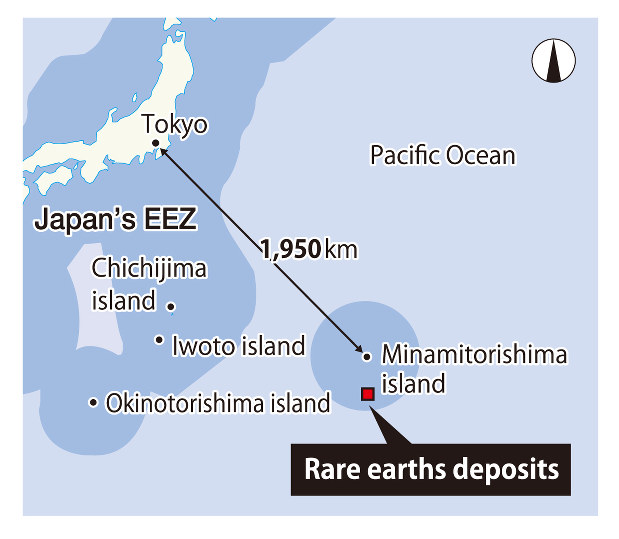
Japan and the United States are moving ahead with plans for what would be the world's deepest undersea mine, targeting rare earth rich mud on the seabed around Minamitorishima, a small Japanese island about 1,900 kilometres southeast of Tokyo. Reporting published on 12 August 2026 shows the project has left the exploration stage and entered engineering trials, with work now focused on preparing a full scale extraction test and on building the separation and refining capacity that would sit behind it. The deposits lie roughly 6,000 metres below the surface, deeper than any offshore oil operation currently in service.
The push is a direct response to a supply squeeze that began in November 2025. After Prime Minister Sanae Takaichi made remarks about Taiwan, Beijing tightened dual use export controls aimed at Japan, then widened them in January 2026 and twice more in February 2026. Chinese customs figures show shipments of dysprosium oxide and terbium oxide to Japan have stood at zero since November 2025, with only negligible yttrium volumes recorded since December 2025. Reuters reported on 20 July 2026 that China shipped no dysprosium, terbium, yttrium or gallium to Japan during June. Exports of the seven controlled rare earth categories to Japan fell 51 percent year on year across the first half of 2026, against a 16 percent decline globally.
The pressure is targeted rather than general. China shipped around 5,649 tonnes of rare earth magnets worldwide in June 2026, up from about 4,730 tonnes in May, so finished magnet trade kept growing while upstream oxide and metal flows to Japan stayed shut. That combination squeezes Japanese magnet makers at the point where they depend on Chinese inputs while Chinese producers compete with them in finished goods.
Japan runs the largest rare earth magnet industry outside China but still imports around two thirds of its total rare earths from China and almost all of its heavy elements. Dysprosium and terbium are added to neodymium iron boron magnets so they hold their magnetic strength at the high operating temperatures found in electric vehicle motors, direct drive wind turbines, industrial robots and defence actuators. Yttrium serves a different set of uses, including plasma resistant coatings in semiconductor equipment and phosphors for displays. Japanese government estimates put the cost of a three month supply interruption at more than 4 billion dollars for domestic companies, with a year long halt cutting close to 0.5 percent from annual GDP.
The technical groundwork has already been laid. The deep sea drilling vessel Chikyu reached the test site on 17 January 2026 and recovered its first sediment on 1 February 2026, lifting mud continuously from between 5,700 and 6,000 metres. Around 50 tonnes were brought up in total, the first time Japan had sustained continuous extraction at that depth. On 24 July 2026 the Cabinet Office released the analysis of those samples, showing that medium and heavy rare earths make up roughly 54 percent of the rare earth content, with yttrium, gadolinium and dysprosium among the elements identified. Radioactivity levels in the samples were low, which makes processing simpler than for many land based heavy rare earth ores.
The next milestone is a one month trial starting in February 2027, designed to raise 350 tonnes of mud per day. It covers three verification goals. The first is whether the lifting system runs reliably under long duration, high load conditions at 6,000 metres. The second is the handling chain, with mud transferred to Minamitorishima for dewatering, a step expected to cut volume by about 80 percent, before shipment to mainland Japan. The third is pilot scale separation, refining and smelting on the mainland. The project team will pull together cost, equipment efficiency and throughput data across mining, ocean transport and hydrometallurgical processing, and must deliver a full industrialisation feasibility report by March 2028.
Washington entered the picture at the March 2026 White House meeting between Takaichi and President Donald Trump, where the two governments signed a memorandum of cooperation on deep sea mineral development and set up a working group to share data and examine joint projects. Their joint statement described the Minamitorishima deposits as capable of meeting centuries of industrial demand. A 2018 University of Tokyo study estimated the seabed south of the island holds more than 16 million tonnes of rare earth minerals, including enough yttrium to cover roughly 780 years of global demand. Houston based offshore engineering firm Deep Reach Technology has held initial meetings with Japanese officials, though those talks remain at an early stage, and the company already works on a separate polymetallic nodule project inside the same exclusive economic zone. In April 2026 Trump ordered federal agencies to accelerate licensing and permitting for seabed projects at home and abroad.
The obstacles are substantial. Water pressure at the site is around 600 times that at sea level, no seabed mining project anywhere has reached commercial scale, and international rules for the activity are still being debated. Dewatering technology, transoceanic logistics costs and the economics of separation and refining all remain unresolved. Japan has spent about 40 billion yen, close to 250 million dollars, on the effort since 2018, and an estimated 340 billion yen, around 2.1 billion dollars, would be needed to stand up a domestic chain from extraction through refining. One private sector estimate puts the resulting production cost at roughly three times land based extraction in China. Takaichi's long term growth strategy anticipates about 5.7 billion dollars in combined public and private funding for deep sea resource development by 2040. Some Japanese officials privately accept that nothing will be running commercially during the remainder of the current US presidential term, which raises questions about how durable American backing will prove.
A security dimension runs alongside the resource question. Chinese oceanographic survey ships have repeatedly worked the seabed close to the edge of Japan's exclusive economic zone around the island, and Chinese research output on the region has grown. In June 2025 a Chinese aircraft carrier entered the Minamitorishima exclusive economic zone for the first time, a brief transit that broke no international law but prompted a protest from Tokyo. In June 2026 a Type 12 surface to ship missile launcher arrived on the island together with an electronic warfare system and a Scan Eagle II drone, described by defence officials as intended for live fire testing into the sea. The Defence Ministry is weighing additional radar, a runway extension and new harbour facilities. China's foreign ministry says its marine scientific research serves peaceful purposes and that its naval activity in the area follows international law.
For buyers, the practical read is unchanged in the near term. No material from Minamitorishima will reach the market for years, and the February 2027 trial is the checkpoint that decides whether the project scales further or stalls.
💡 Alternative Solution
Deep-sea rare earth extraction at Minamitorishima with a 350 tonne per day trial in February 2027, heavy rare earth supply from Lynas Rare Earths in Australia and Malaysia, Japanese-backed separation capacity in France, magnet recycling and scrap recovery, low-dysprosium and dysprosium-free magnet designs, grain boundary diffusion to cut heavy rare earth loading, JOGMEC stockpile releases, long-term offtake agreements with US and Australian producers, US-Japan joint working group on deep sea mineral development