What Is the US Plan for Iran After the War?
The military confrontation between the United States, Israel, and Iran that dominated the first half of 2026 has shifted decisively from combat to reconstruction.
After more than five weeks of fighting under Operation Epic Fury, a ceasefire took hold in early April, and on June 18, 2026, Presidents Donald Trump and Masoud Pezeshkian signed a memorandum of understanding designed to bring the war to a formal end within 60 days.
On June 14 mediators, including Pakistani Prime Minister Shehbaz Sharif, announced the framework, and minutes later Trump declared the immediate lifting of the US naval blockade on ships docking at Iranian ports. The Strait of Hormuz, one of the world's most sensitive oil chokepoints, began reopening to commercial traffic. This shift marks the moment Washington moved away from major combat operations and toward what US military doctrine labels the later phases of an operational plan.
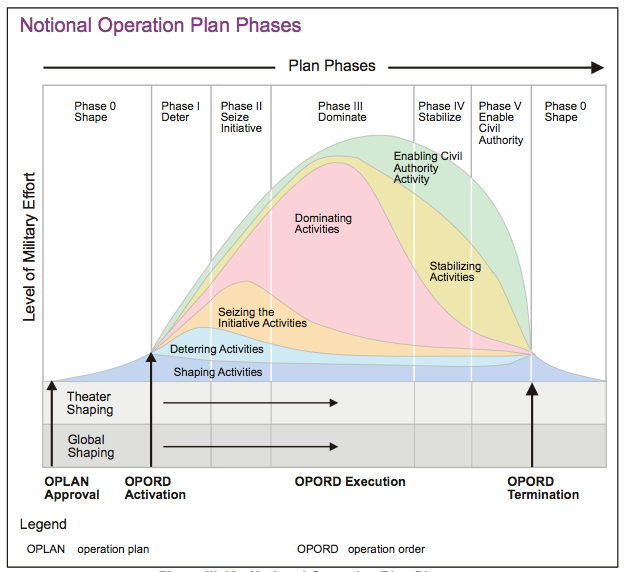
The framework that guides US thinking here comes from a long-standing planning construct published by the Joint Chiefs of Staff in 2011, often illustrated by a chart titled Notional operational plan phases versus level of military effort. The word notional is worth explaining because it is uncommon outside military and engineering circles. It means hypothetical or representative rather than fixed. A notional plan is an illustrative template that shows how a campaign is expected to unfold in theory, not a literal schedule of events. Planners use notional models to reason about resource allocation and risk before reality forces adjustments.
The doctrine divides operations into six sequential phases. Phase 0 is shape, in which forces set conditions and build relationships before any conflict. Phase I is deter, applying pressure to discourage an adversary from acting. Phase II is seize initiative, the opening moves of active conflict. Phase III is dominate, the culminating period of major combat operations where the bulk of military attention and resources is traditionally concentrated. Phase IV is stabilize, restoring basic order and services once large-scale fighting ends. Phase V is enable civil authority, transferring responsibility back to a functioning local government. The model assumes a linear progression that peaks at Phase III and then descends through a post-conflict period of stabilization and transition. Critics of the doctrine have long pointed out that adversaries often pursue their goals below the threshold of open war, while planners remain fixated on the big fight at Phase III.
Applied to Iran, the United States has now passed through its dominate phase and is attempting to engineer Phase IV stabilization and Phase V transition. The combat record was severe. Supreme Leader Ali Khamenei was killed during strikes on March 1, 2026, and senior Islamic Revolutionary Guard Corps commanders died in the fighting. His son Mojtaba Khamenei assumed the role of Supreme Leader on March 8, 2026, while President Pezeshkian, regarded as a relative moderate, retained his office and briefly served on an interim leadership council during the succession. This leadership picture matters because the ideal US outcome, as reflected in the March 2026 15-point proposal and the final 14-point memorandum, is an Iran governed by pragmatic figures who favor economic development over confrontation and who end the use of armed proxies across the region.
The stabilization package is substantial. Under the memorandum, the United States undertakes with regional partners to develop a plan worth at least 300 billion dollars for the reconstruction and economic development of Iran, with the implementation mechanism to be finalized within 60 days of a final deal. Washington also commits to terminating sanctions, including United Nations Security Council resolutions and unilateral US measures, unfreezing Iranian assets, and issuing waivers for oil exports. In exchange, Iran affirms it will not develop nuclear weapons, agrees to address its stockpile of enriched material through on-site down-blending under IAEA supervision, and commits to a permanent end to military operations on all fronts, including Lebanon. Iran also agreed to ensure safe passage for commercial vessels through the Strait of Hormuz at no charge for 60 days.
The path forward remains uncertain. Direct negotiations on the final agreement were expected to begin in mid-June, and Trump warned of renewed military action if Iran violated the terms. Analysts question whether a regime navigating a leadership succession and facing the largest sustained protest wave since 2022 can absorb reconstruction aid while maintaining internal control. The IAEA has been unable to resume inspections to verify the state of Iran's nuclear program. Hamas and Hezbollah have rejected disarmament. The notional doctrine assumes a clean handoff from combat to civil authority, yet the Iranian case shows how messy that transition becomes when the political ground is still shifting. For global supply chains, the immediate consequence is the reopening of Hormuz and the gradual return of Iranian oil to world markets, easing the fuel shortages that had rippled across Asia during the blockade.
These developments can be read through the lens of French historian Philippe Fabry, whose comparative approach to revolutions and political transitions offers a framework for understanding what may be happening in Tehran. In Fabry's reading of history, a regime that has lost its ideological energy and its financial means becomes an old order ripe for replacement, much as the French monarchy was before 1789. The argument applied to Iran runs as follows. The Islamic Republic is short of money, which limits its ability to buy the loyalty of segments of the population that once kept it in power through subsidies and patronage. It has been defeated in the air, where the United States and Israel established clear dominance, yet Washington has shown no appetite for a costly ground war to finish the job. The killing of its most senior figures, including Supreme Leader Ali Khamenei and top Revolutionary Guard commanders, has thinned the hardline leadership and opened space for more moderate successors to rise. What observers are watching now is an internal power struggle between pragmatists who favor negotiation and economic recovery and the remaining hardliners who built their authority on confrontation. The outcome of that contest, more than any external plan, will decide whether Iran completes the transition the United States hopes to see.