US Gas Heads to Asia via Mexico as US Pacific Coast Stays Shut
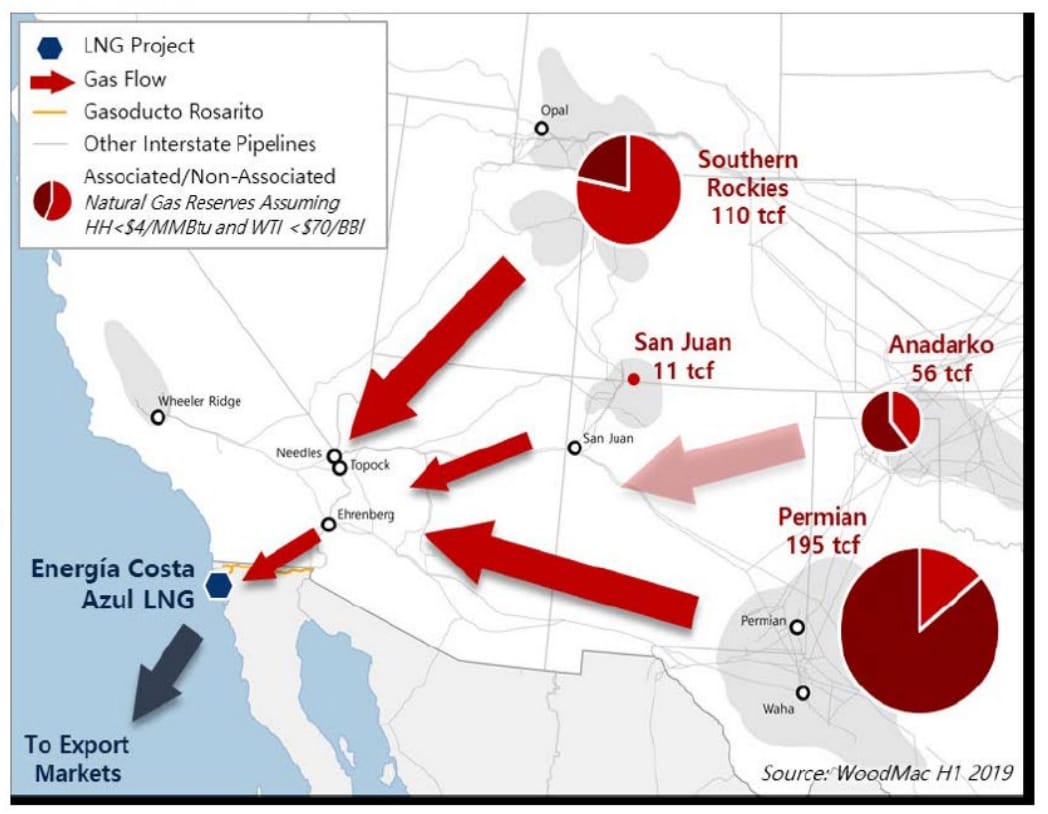
The Pacific coast of Mexico is emerging as a key node in global liquefied natural gas (LNG) supply chains, with several terminals racing to come online as Asian buyers scramble for alternatives to Qatari and Emirati cargoes blocked by the ongoing Strait of Hormuz crisis.
Sempra Infrastructure introduced first feed gas into its Energia Costa Azul (ECA) Phase 1 export terminal on 28 April 2026, marking the start of commissioning at the first large-scale LNG export facility on Mexico's Pacific coast. The plant, located north of Ensenada in Baja California, has a nameplate capacity of 3.25 million tonnes per year. On 7 May 2026, Sempra confirmed the terminal targets first LNG production in June 2026, with TotalEnergies and Mitsui & Co holding combined offtake of 2.5 million tonnes per year under 20-year agreements.
ECA sources its natural gas from West Texas, New Mexico and Rocky Mountain basins, with feed gas demand expected to reach roughly 425 million cubic feet per day at full capacity. Sempra secured a six-month extension from the US Department of Energy on the export commencement deadline that had been set for 29 March 2026. The project reached 95 percent completion in late 2025 after delays linked to labor and productivity challenges had pushed the original 2024 startup target back by more than 18 months.
Approximately 750 kilometres south of Ensenada, the Amigo LNG project at the Port of Guaymas in Sonora began site preparation activity in March 2026. The terminal, a joint venture between Texas-based Epcilon LNG and Singapore-based LNG Alliance, is designed for 7.8 million tonnes per year of capacity through floating liquefaction units fabricated by Drydocks World in Dubai. The partnership announced in late 2025 that it intends to take a final investment decision in early 2026, with first cargoes targeted for October 2028. Around 85 percent of Train 1 capacity has been placed under binding contracts with four offtakers, primarily targeting Asian markets. Amigo LNG would draw feed gas from the Permian Basin's Waha hub via the existing Trans-Pecos, Ojinaga-El Encino, El Encino-Topolobampo and Guaymas-El Oro pipeline network.
A third major project, the 14.1 million tonnes per year Saguaro Energia LNG terminal proposed by Mexico Pacific Limited in Puerto Libertad, Sonora, has run into serious difficulties. As of late 2025 the developer had not reached a final investment decision, ownership had changed hands at least five times since 2019, and the project's US Department of Energy export permit expired on 14 December 2025. A March 2026 assessment from environmental groups described the project as hitting the rocks amid mounting financial, environmental and regulatory headwinds. Saguaro had planned to draw gas from the San Juan Basin and Permian via a dedicated 800-kilometre Sierra Madre pipeline.
Smaller projects on the Pacific coast include Vista Pacifico LNG in Topolobampo, Sinaloa, led by Sempra at 3 to 4 million tonnes per year, and the proposed Gato Negro LNG. None has reached final investment decision as of May 2026.
The strategic logic behind routing US Permian and Rocky Mountain gas through Mexico rather than US Gulf Coast terminals rests on several factors.
The US Pacific coast remains effectively closed to LNG export development. The Jordan Cove project in Oregon was abandoned in 2021 after sustained opposition, and no operational or permitted export terminal exists on the entire US west coast. Without a Pacific outlet on US soil, gas from the Permian Basin and surrounding fields has no direct shipping route to Asia.
Tankers loaded at Sabine Pass, Corpus Christi or other Gulf of Mexico facilities must transit the Panama Canal to reach Asian customers. Recurrent drought conditions in 2023 and 2024 imposed severe transit restrictions on the canal, and slot reservations for LNG carriers remain expensive and limited. Shipping distance from Houston to Tokyo via Panama runs about 16,000 kilometres. From Ensenada or Guaymas, vessels reach Tokyo in roughly 10,000 kilometres without canal exposure, cutting voyage time by around five to seven days.
The Permian Basin also generates structural oversupply of associated natural gas extracted alongside oil. Waha hub spot prices have repeatedly turned negative since 2023, with producers paying buyers to take volumes off their hands or flaring excess gas at the wellhead. Pacific Mexico exports offer producers a low-cost outlet for stranded supply that would otherwise be vented or burned. Forward data showed Waha hub fixed prices averaging around 2.00 USD per MMBtu for 2026 before climbing to 3.30 USD as new export demand ramps up.
Cross-border arrangements also sidestep some US permitting friction. The Biden administration's January 2024 pause on new non-FTA (Free Trade Agreement) LNG export licences accelerated developer interest in Mexican projects, which can secure US gas under existing pipeline export authorisations and re-export it as LNG from Mexican soil. The Trump administration lifted the pause in early 2025, but the Mexican projects had already advanced their commercial positions.
The shift coincides with deep dislocation in global LNG flows. The closure of the Strait of Hormuz that began in early February 2026 has cut off most Qatari and Emirati LNG exports, removing roughly 30 percent of pre-crisis global supply from the market. Asian buyers including Japan, South Korea, Taiwan and China have turned to US Gulf Coast cargoes, Australian volumes and smaller Atlantic Basin suppliers to plug the gap, but the resulting bidding war has pushed Asian spot LNG prices well above 20 USD per MMBtu in March and April 2026. A 1 April 2026 industry report stated that Mexico Pacific coast projects have been flooded with offtake queries as global buyers scramble for de-risked supply.
Mexican President Claudia Sheinbaum announced on 3 February 2026 that a wave of private investment worth roughly 7.5 billion USD would launch in the first quarter of 2026 around the Port of Guaymas expansion led by the Mexican Navy (SEMAR), with the Amigo LNG terminal as the central pillar.
The combined effect is that Mexican Pacific coast capacity available to global markets in 2026 will be limited to ECA Phase 1 output, with broader buildout dependent on financing, permitting and Permian pipeline expansion through 2027 and beyond. Asian buyers therefore face a transitional period in which Mexican supply mitigates but does not fully replace Hormuz-blocked volumes, with full diversification only available toward 2028.
💡 Alternative Solution
US Gulf Coast LNG via Panama Canal, Australian Pacific exports, Canadian LNG Canada Phase 2, increased coal-fired generation in Asia, demand reduction and gas-to-renewables switching, Russian pipeline gas to China, Atlantic Basin LNG redirection