Singapore Fuel Supply Running on Reserves as Hormuz Closure Cuts Off Most Oil Imports
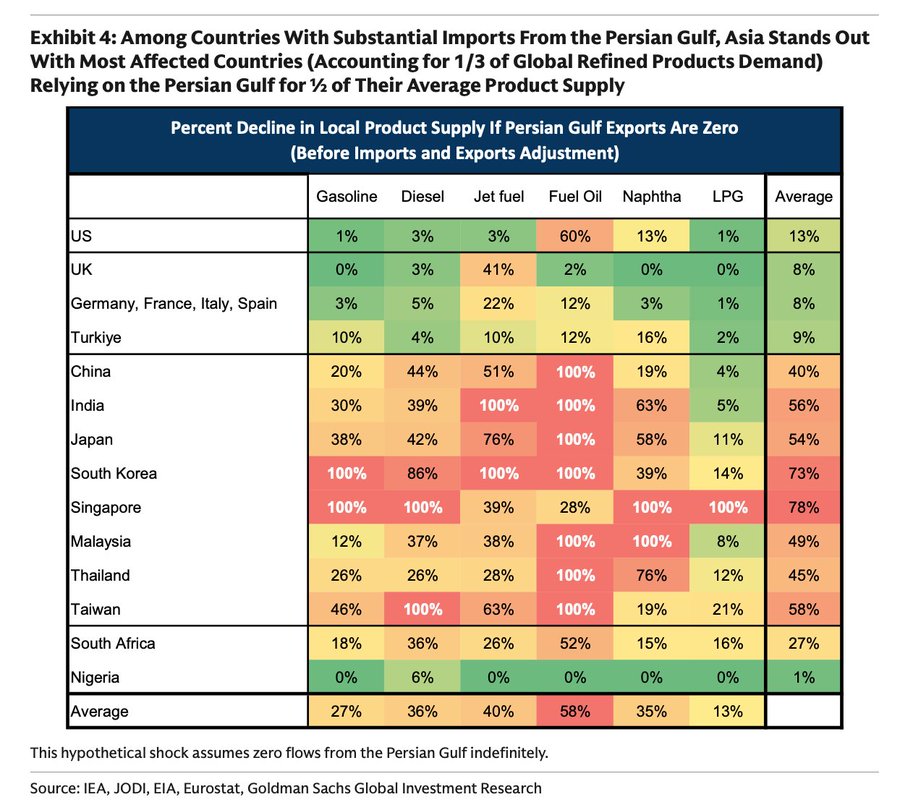
Singapore, one of the world's top three oil refining centers, is facing a growing fuel supply crisis triggered by the closure of the Strait of Hormuz following the outbreak of the US-Israeli war on Iran on February 28, 2026. The city-state, which relies on imports for all of its energy needs, has seen its refineries forced to cut output sharply as feedstock from the Persian Gulf dries up.
Singapore's dependence on Middle Eastern crude oil reached over 70 percent in 2025, up from around 50 percent in 2024. This increase was largely driven by ExxonMobil's completion of a major refinery expansion on Jurong Island that requires greater volumes of heavy, high-sulfur crude from the Gulf. The timing proved disastrous. With the Strait of Hormuz effectively blocked since early March 2026, Singapore's three main refineries on Jurong Island, which together can process roughly 1.38 million barrels per day, have been forced to scale back operations. The Singapore Refining Company (SRC), a joint venture between PetroChina and Chevron with a capacity of 285,000 barrels per day, has been running at approximately 60 percent since early March due to constrained crude availability.
The disruption extends beyond crude oil. Around 45 percent of Singapore's liquefied natural gas (LNG) imports came from Qatar in 2025, and about 95 percent of Singapore's electricity is generated from imported natural gas. For refined products specifically, Singapore has among the highest diesel import dependencies from the Gulf in Southeast Asia. LPG is even more exposed, as most of Singapore's LPG is produced locally by Jurong Island refineries that rely on Gulf crude as feedstock. Across Southeast Asia, around 70 percent of imported LPG originates from the Middle East.
As most of Singapore's refineries were built and configured to process Middle Eastern heavy crude, switching to alternative grades from other regions affects product yields and is not a straightforward substitute.
The effects on consumer prices have been immediate and severe. Diesel prices at the pump surpassed those of 95-octane petrol for the first time in Singapore's history in mid-March 2026. By late March, diesel reached SGD 3.83 per liter, nearly double the historical average. This matters because 85 percent of Singapore's goods vehicles run on diesel, meaning logistics and transportation costs are rising across the board. Bunker fuel prices at Singapore's port, the world's largest bunkering hub, exceeded USD 1,000 per ton in early 2026, prompting marine fuel distributors to cut back on purchases amid extreme price volatility.
Electricity tariffs for households rose by 2.1 percent for the April to June quarter, but this reflects only a partial impact since the tariff calculation is based on fuel costs from January to mid-March. The Energy Market Authority (EMA) has warned that sharper increases are expected in subsequent quarters as the full weight of higher gas prices feeds through. The wholesale electricity price hit its highest level in 2026 during the last week of March at SGD 169.23 per megawatt hour. Ride-hailing platform Grab announced a temporary fuel surcharge increase from SGD 0.50 to SGD 0.90 per trip, effective from April 7 to May 31, 2026.
In a sign of the lengths to which companies are going to maintain operations, PetroChina shipped a rare cargo of 1.8 million barrels of Murban crude from its storage facilities in Dalian, northeast China, to the SRC refinery on Jurong Island in late March. China rarely exports crude oil, making this an exceptional move that underscores the severity of the supply crunch. Meanwhile, Singapore-based petrochemical firm Aster Chemicals and Energy has declared force majeure, indicating it may not be able to fulfill its contractual obligations.
The Singapore government has activated its Homefront Crisis Ministerial Committee, chaired by Coordinating Minister for National Security K. Shanmugam and reporting directly to the Cabinet. On April 4, Shanmugam told reporters that price increases are unavoidable, not just for fuel but across goods affected by global supply chain disruptions, including food. Singapore imports nearly all of its food, and rising fertilizer and transport costs will inevitably push food prices higher.
The government's official position on fuel reserves remains deliberately opaque. Energy Minister Tan See Leng has stated that stockpiles are sufficient for several months but has declined to provide exact figures, citing national security. This contrasts with other Asian nations that have publicly disclosed their reserve levels. For reference, Japan holds 254 days of reserves, China 115, Thailand 95, the Philippines 55, Vietnam 45, and Indonesia 23. Singapore's refusal to disclose suggests a reserve level that is adequate but not overwhelming.
Singapore benefits from the Jurong Rock Caverns, an underground storage facility located 130 meters beneath Jurong Island with a capacity of 1.47 million cubic meters for storing crude oil, condensate, naphtha, and gas oil. Combined with above-ground storage on Jurong Island, total storage capacity exceeds 90 million barrels. However, these reserves were designed as a commercial buffer for the refining industry, not as a national strategic petroleum reserve in the traditional sense.
Singapore and Australia signed a bilateral agreement in late March to maintain energy trade flows. Under the arrangement, Australia would help fill Singapore's LNG shortfall while Singapore would continue supplying refined fuels to Australia, which depends on Singapore and other Asian refiners for over 80 percent of its petrol, diesel, and jet fuel. Thailand and China have both imposed fuel export bans, further limiting the availability of alternative refined product sources in the region.
Despite the mounting pressure, Singapore has not yet imposed energy-saving restrictions, unlike the Philippines (four-day work week), Thailand and Vietnam (government work-from-home mandates), and Myanmar (alternating driving days). This restraint reflects Singapore's stronger fiscal position and deeper reserves, but officials have made clear that such measures remain on the table if the situation worsens. The core vulnerability remains: Singapore's refining infrastructure is structurally tied to Gulf crude, and no amount of financial reserves can fully substitute for physical barrels of oil that are not arriving.
Source of the heatmap:
🔹 "Are We Running Out of Oil?" (April 2026). Yulia Zhestkova Grigsby (lead), Alexandra Paulus, and Daan Struyven at Goldman Sachs & Co. LLC.
💡 Alternative Solution
Crude oil sourcing from non-Gulf suppliers (Russia, Malaysia, West Africa, US), bilateral energy agreements with Australia for LNG-fuel swaps, tapping Jurong Rock Caverns underground reserves, refinery crude slate optimization for alternative grades, strategic drawdown of commercial petroleum stockpiles, demand reduction measures under government crisis committee review