EU Pays Russia EUR 1.6bn in April 2026 as LNG Imports Surge Amid Hormuz Crisis
The Centre for Research on Energy and Clean Air (CREA) is an independent research organisation that tracks fossil fuel trade flows, emissions, and the financial revenues of fossil fuel-exporting nations. Since Russia's full-scale invasion of Ukraine in February 2022, CREA has published monthly analyses of Russian fossil fuel export revenues and the effectiveness of Western sanctions.
In April 2026, the five largest EU importers of Russian fossil fuels collectively paid Russia EUR 1.6 billion, according to CREA's monthly report published on 11 May 2026. Natural gas accounted for 88% of that total, split between EUR 957 million in LNG and EUR 419 million in pipeline gas. An additional EUR 189 million was paid for crude oil transported via the Druzhba pipeline.
This data reflects a broader pattern that has intensified since the closure of the Strait of Hormuz in late February 2026, following the outbreak of conflict between the US, Israel, and Iran. With Qatari LNG supplies severely disrupted and only two LNG carriers transiting the Strait of Hormuz in April, European gas markets have remained under sustained pressure. Dutch TTF gas prices surged 68% within two days of the first strikes and remain elevated, up 24% year-on-year in April. Russia has directly benefited: its pipeline gas revenues increased 15% month-on-month despite a 7% drop in export volumes, as higher European prices compensated for the volume decline.
France remained the EU's largest buyer of Russian LNG in April, purchasing EUR 413 million worth - a 13% month-on-month increase - even as its total LNG unloadings fell 2% over the same period. This divergence points to a deliberate increase in the share of Russian LNG within France's overall import mix, rather than a rise in total demand.
Belgium was the third-largest EU importer, purchasing EUR 363 million in Russian LNG - a 33% month-on-month jump - while its total LNG unloadings simultaneously dropped 3%. The same pattern as in France is visible: Russian LNG is gaining share within a contracting import pool.
Hungary and Slovakia together received EUR 419 million in Russian pipeline gas via the Balkan Stream pipeline. Hungary was the second-largest EU buyer overall at EUR 380 million, with its imports composed of both pipeline gas and crude oil. The Druzhba pipeline, which had been inactive for nearly three months, resumed deliveries of Russian crude to Hungary and Slovakia on 23 April 2026. Slovakia received EUR 228 million in total - EUR 124 million in pipeline gas and EUR 104 million via the Druzhba pipeline.
Spain, the fifth-largest EU importer, received EUR 181 million in Russian LNG, but its purchases fell sharply by 56% month-on-month. This drop played a significant role in reducing the EU's overall share of Russian LNG imports, which declined 8% month-on-month.
At the bloc level, EU imports of Russian LNG remained high despite the entry into force of the REPowerEU Regulation (EU) 2026/261 on 25 April 2026, which banned spot-market purchases of Russian LNG. The regulation's limited immediate effect reflects the lead time on contracted volumes and the difficulty of rapidly redirecting supply in a constrained global LNG market.
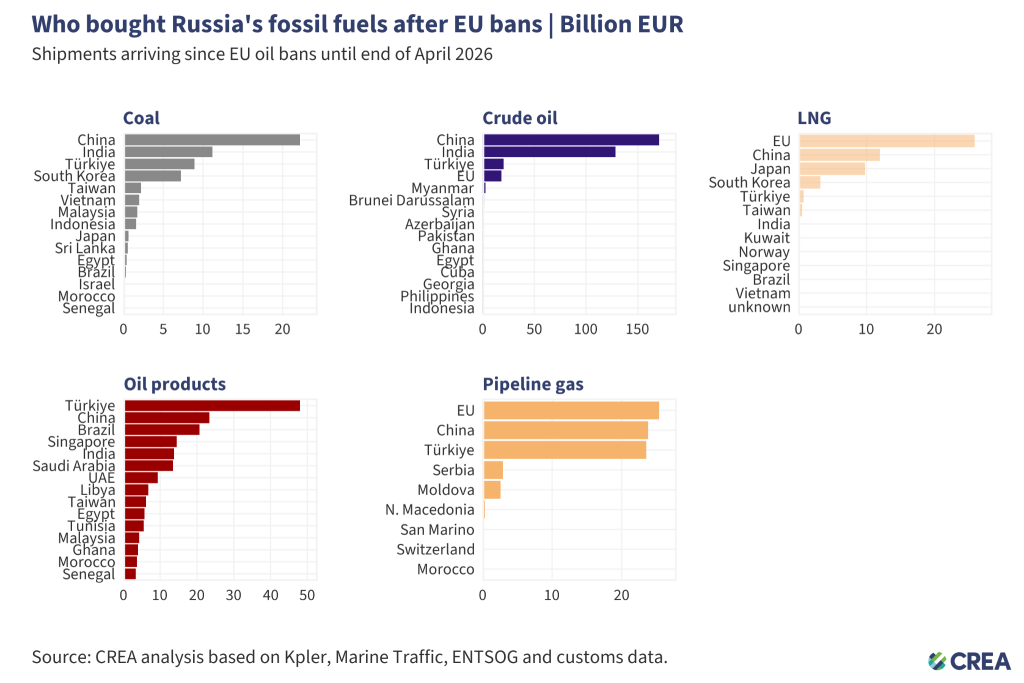
The Ormuz crisis has structurally reshuffled global LNG flows. Chinese and Japanese imports of Russian LNG rose 32% and 57% month-on-month respectively in April, as both countries competed for supply diverted from the Gulf. This redirection of flows has paradoxically strengthened Russia's bargaining position with European buyers who face fewer alternatives in a market already stressed by the Hormuz closure.
Overall, Russia's fossil fuel export revenues reached EUR 733 million per day in April 2026 - the highest level in two and a half years - despite a 7% drop in total export volumes. The revenue increase was driven by higher global energy prices, themselves a direct consequence of the Hormuz disruption. This dynamic illustrates how geopolitical crises in one region can reinforce the financial resilience of sanctioned exporters in another.
💡 Alternative Solution
Accelerated deployment of renewable energy to displace gas-fired generation, diversification of LNG supply sources away from Russia, full enforcement of the EU spot-market ban on Russian LNG, lowering the G7 oil price cap to USD 30 per barrel, closing the refining loophole by applying import restrictions at the refinery level rather than the national level, strengthening attestation fraud prevention for maritime insurance, coordinated G7 ban on ship-to-ship transfers of Russian oil in allied waters