America Just Decided the Deep Sea Belongs to Whoever Mines It First
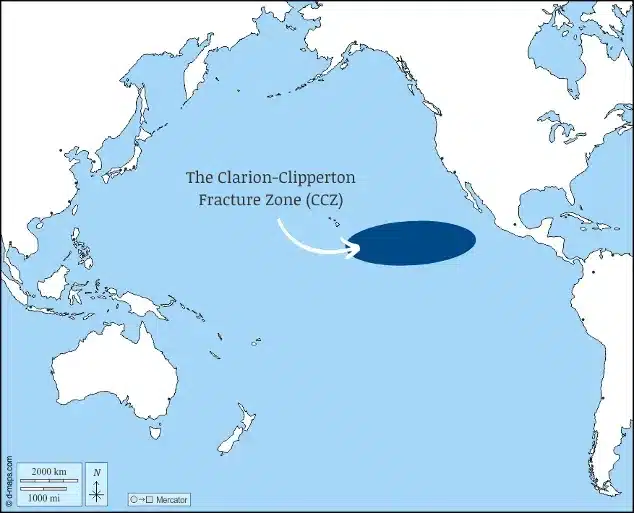
The dispute over who governs mining on the deep ocean floor has hardened into an open institutional conflict between the United States and the International Seabed Authority, and as of August 2026 no settlement is in sight. Washington is issuing exploration licences and commercial recovery permits for the Clarion-Clipperton Zone under its own domestic law, while the United Nations body created to administer that same seabed maintains that the area cannot be claimed or licensed by any single state. No nodules have been recovered commercially so far, so physical supply of nickel, cobalt, manganese and copper is not yet affected, but the legal framework that future buyers would have to rely on is being contested in real time.
The current phase began on 24 April 2025, when President Trump signed Executive Order 14285 on offshore critical minerals. The order instructed federal agencies to accelerate permitting under the Deep Seabed Hard Mineral Resources Act of 1980, a statute the United States kept in force after declining to join the UN Convention on the Law of the Sea. Under that law the National Oceanic and Atmospheric Administration can license mining in international waters without any reference to the International Seabed Authority. In January 2026 NOAA published a final rule merging exploration and commercial recovery into a single consolidated application, cutting the number of separate reviews an applicant has to clear.
The first consolidated application came from TMC USA, a subsidiary of The Metals Company. NOAA found it in substantial compliance in early March 2026 and in full compliance on 28 April 2026. It covers roughly 65,000 square kilometres with an estimated 619 million tonnes of wet nodules and potential upside of another 200 million tonnes. A second filing, for the 122,000 square kilometre USA-B area holding an estimated 1.02 billion tonnes, was certified on 26 May 2026. Other applicants have followed the same route. American Ocean Minerals Corporation lodged two exploration applications covering more than 1.4 billion tonnes of inferred resources and announced an all-stock merger with Odyssey Marine Exploration on 8 April 2026, while Deep Sea Rare Minerals has signalled a consolidated filing of its own.
The International Seabed Authority has not conceded the point. Its Council session in Kingston, which ran from 9 to 19 March 2026, closed without agreement on the long-delayed Mining Code, and members instead pushed forward an inquiry into whether contractors sponsored through the multilateral system breached their obligations by pursuing a parallel American route. TMC subsidiaries NORI and TOML took the Authority to the International Tribunal for the Law of the Sea. On 18 July 2026 the Seabed Disputes Chamber prescribed provisional measures requiring the Authority to respect the contractors' due process rights, and two days later the Council extended NORI's exploration contract by five years. The inquiry into contractor conduct is still running.
At the ISA assembly that closed at the end of July 2026, secretary-general Leticia Carvalho circulated a draft asking member states to request an advisory opinion from the tribunal on whether the deep seafloor can be appropriated by any single country, and on whether other governments should decline to recognise permits issued outside the multilateral system. Russia and China supported the request. The African group, New Zealand, Norway, France, Singapore, Jamaica and Canada indicated they could back it but wanted more legal preparation. No consensus emerged, so the assembly handed the file to consultations led by Malta and pushed the decision to its 2027 session. In parallel, the campaign for a moratorium on commercial extraction now counts 46 supporting governments after Mauritius, Mozambique and the Republic of Congo joined.
The prize sits in the Clarion-Clipperton Zone, an abyssal plain in the North Pacific bounded by two fracture zones running west from the coast of Mexico towards Hawaii. Depending on how the boundaries are drawn, the region covers between roughly 4.5 million and 9 million square kilometres of international waters, with the seafloor lying about 4,000 to 5,500 metres down. Scattered across it are potato-sized polymetallic nodules that grew a few millimetres every million years around fragments of shell or rock. Authority estimates put the total at around 34 billion tonnes of nodules containing on the order of 340 million tonnes of nickel, alongside very large volumes of manganese, copper and cobalt. A United States Geological Survey review used a more conservative figure of 21.1 billion dry tonnes and still concluded that several of these metal tonnages exceed known reserves on land. All of these are estimates of metal in place rather than reserves that can be recovered at a profit.
Collecting nodules does not involve digging in the usual mining sense. They lie loose on the sediment surface or just beneath it, so there is nothing to blast, no shaft to sink and no overburden to strip. A tracked collector vehicle about 12 metres long is lowered to the seabed and driven remotely from the surface, connected by an umbilical cable for power and control. Jets of seawater lift the nodules off the top few centimetres of mud, and the mixture of nodules, sediment and water is drawn into the machine. From there it travels up a vertical riser pipe roughly 4.5 kilometres long to a production vessel, in this case the converted drillship Hidden Gem, where nodules are separated from water and sediment and stored before transfer to bulk carriers. The leftover water and fine sediment are discharged back into the ocean, and that discharge is one of the main environmental questions scientists have raised. Pilot trials in 2022 collected about 4,500 tonnes of nodules and lifted more than 3,000 tonnes to the surface, reaching a sustained rate of 86.4 tonnes per hour. The commercial system, covered by an agreement signed with Allseas on 11 May 2026, targets 3 million wet tonnes a year with commissioning planned for the fourth quarter of 2027.
For buyers of battery and alloy metals the near-term picture is unchanged. Nothing from the Clarion-Clipperton Zone will reach the market before 2028 at the earliest. TMC said on 13 August 2026 that the certification of its main application had slipped by a few months, although it still expects the permit ahead of vessel commissioning. Processing is the other bottleneck. Nodules require a refining route that separates four or more metals from the same feed, something no commercial plant does at scale today. TMC USA signed a services agreement with Mariana Minerals on 21 July 2026 for design work on a processing and refining park at the Port of Brownsville in Texas, and the company has stated that most of the onshore capital would have to come from United States government sources. Glomar Minerals and Cobalt Blue have announced a separate refinery project aiming for commercial production within three years.
The commercial risk is therefore legal rather than physical. A cargo produced under an American permit would enter a market where a large group of states may treat the underlying title as invalid, which raises practical questions about port access, insurance, offtake contracts and the exposure of sponsoring states. Sourcing teams looking at nodule-derived nickel or cobalt in the late 2020s will need to check the title status of the cargo as carefully as its grade. That uncertainty is precisely what the proposed advisory opinion is meant to address, and it will not be resolved before 2027.
Whether the American approach amounts to a new phase of resource imperialism depends on which legal starting point is accepted. Critics note that the seabed beyond national jurisdiction was defined by treaty as the common heritage of humankind, and that a state acting outside that framework converts shared property into a national concession, while small Pacific sponsoring states lose the leverage the multilateral system was designed to give them. The United States answers that it never ratified the convention, does not regard its seabed provisions as customary international law, and is exercising high seas freedoms under a statute that predates the Authority. The State Department told the ISA in July 2026 that responsible seabed mineral development is a strategic national security and economic priority tied to critical mineral supply chain security. Both positions are now being tested at once, one through NOAA permits and vessel construction, the other through tribunal proceedings and a widening moratorium coalition, and the gap between the two systems is no longer being papered over.
💡 Alternative Solution
Land-based nickel and cobalt supply from Indonesia, the Philippines, Australia and the Democratic Republic of Congo, exploration contracts held through the International Seabed Authority by China, Japan, India, South Korea, Germany, France and Belgium as a multilateral route to the same resource, battery chemistries that cut nickel and cobalt intensity such as lithium iron phosphate and sodium-ion, expanded black mass recycling and secondary metal recovery, national stockpiles and strategic mineral reserves, long-term offtake agreements with established refiners, and legal due diligence on the title status of any nodule-derived cargo before contracting